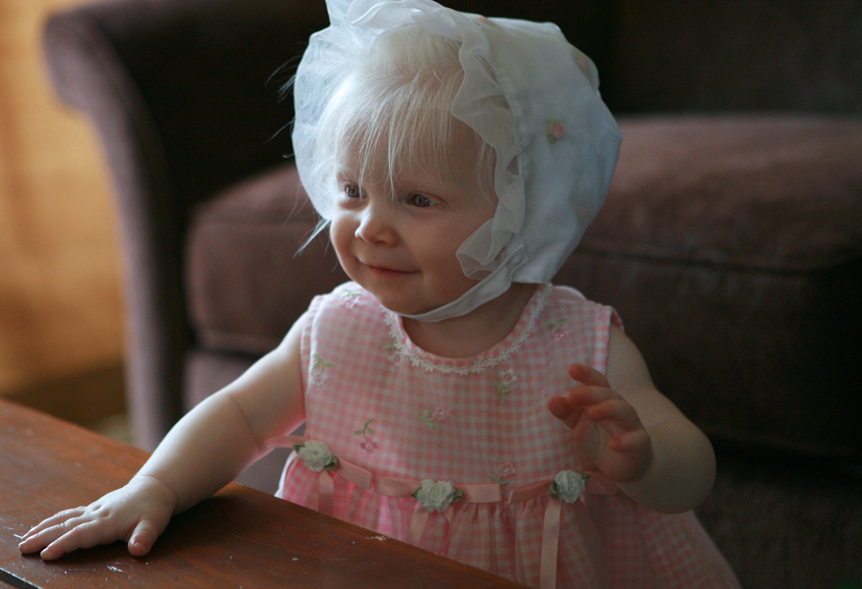
My daughter Lyra was born on May 11th 2006. She had white, almost clear hair at birth. Even though our older two kids were born with dark hair, we weren’t terribly shocked since I had a brother and a niece who were both born with white hair. Albinism was suspected immediately by the doctors, but it wasn’t until 2 days after birth when she was examined by the Pediatric Ophthalmologist, that the diagnosis was confirmed. Lyra had Oculocutaneous Albinism. It was unbelievably hard to deal with at first. During the first couple of weeks, there was always that little bit of hope, that maybe they were all wrong. I had endless thoughts and questions racing through my mind, yet I didn’t want to tell anyone or talk about it. When we left the hospital, they gave us a packet of information about albinism. When we got home, I didn’t want my daughter to accidentally see it, so I hid it in the back of my closet. The stress was overwhelming. I wanted to scream every time someone would say “Wow, look at that white hair.” After a week or two of denial along with a serious case of postpartum depression, I finally accepted it… I had a sweet, beautiful, platinum blonde baby girl who couldn’t have been more perfect.
I immediately began researching. I wanted to know everything and anything about albinism. However, with more knowledge, came more pain. I kept receiving indefinite answers to most of my questions. There were too many maybes and what ifs. I thought maybe her visual acuity could be predicted based on the amount of pigment, but no such luck. Her PO (pediatric ophthalmologist) told us that there could be kids with less pigment that see better than those with more pigment and vice versa. Lyra’s future vision couldn’t be predicted by the severity of nystagmus, strabismus, or photophobia she had either. With so many factors to consider, it was impossible to know what her visual acuity would be. I just wanted numbers…numbers more specific than 20/60 to 20/2200. I hated not knowing the future. Would Lyra ever be able to read a book, or ride a bicycle, or see a shooting star? I had to force myself to focus on the now…how could I help her now… what is she doing now…what is she seeing now. If I wondered or asked questions about what she would see in 20 years or 5 years or even 6 months, I’d make myself sick with worry. I had to take it one day at a time, and focus on what matters most, loving and enjoying every moment with my child.
I discovered very quickly that most people were clueless as to the facts about albinism. They think of the stereotype “Albino” that they see on TV. A character that is made fun of or portrayed as weird or scary in many movies today. I would cringe when I heard the word albino. A lot of people are comfortable using the word and not offended when called albino, but I am not. I don’t use the word in reference to Lyra and I will correct anyone who does. Person-first language is being more widely used every day. If someone asks me if she is an albino, I say “No. She is a baby and her name is Lyra. She just happens to have albinism.” She is special and unique because of who she is not because she has albinism. One thing that adds to this negative association I have with the word is that ironically, I was teased and called “albino” in middle school. I do have very light skin and I never jumped into the tanning beds like everyone else did back then, but I don’t have albinism. What do you call a child who has a hearing impairment, or autism, or a physical or developmental disability? You call him or her a person, not a disease. Labels that may have been acceptable decades ago such as mute, dumb, crippled, or retarded, are no longer used and are offensive to most.
I found that very few people know albinism is a genetic condition or that people with albinism have visual impairments. And then there were those people who THOUGHT they knew everything about albinism when really, they knew nothing but a bunch of myths. I got so sick of hearing the same questions and comments over and over again. One thing that upsets me, is when people say something like “Wow…are her eyes red?” NO!, her eyes are blue…but when a bright florescent light is glaring into her eyes…they look pink. I am very defensive on this issue. I try to explain that its the blood behind her eyes and you’re actually seeing through her eyes, but sometimes its just pointless. Some people just don’t get it…and others are just too blinded by the stereotype. One thing that has been helpful to some is when I compare her eyes to a tinted window. If you take a blue tinted window, put a piece of red cloth behind it, and then shine a flashlight on it, the window is going to look pinkish, or purple, depending on the amount of blue tint in the window…but the window is still blue…just like Lyra’s eyes are still blue.
Some people I chose to educate and others I chose to ignore. There are only a few I’d like to smack…but I don’t.
We were fortunate that Lyra was diagnosed so early. She has had regular visits to her pediatric ophthalmologist since birth. At 3 months, her nystagmus, strabismus and photophobia were the primary issues. We were told she would eventually need strabismus surgery, but not how soon that might be. Dr. Grin said Lyra was beginning to show a little bit of farsightedness, but not enough to warrant glasses.
Lyra had her Functional vision evaluation through Early Intervention Services when she was 2½ months old. By 4 months we had completed her IFSP and Lyra began receiving services at home with a teacher of the visually impaired and an occupational therapist once a week. Through her EI, we were able to find out about a lot of great toys and books that would help promote her vision development. Its all about high contrast, lights, and textures. In addition to working on her vision and motor skills, we also began prebraille activities. We read books, encouraging tactile exploration of the various textures of touch & feel books. Troy and I have started learning the basics of braille, but we haven’t moved any further than our ABC’s. This is definitely something we plan to continue with Lyra and for us.
Many people have asked how we can tell what she can or can’t see. When we say legally blind, people often imagine complete darkness. They rarely consider the fact that like many, THEY might be legally blind without their glasses or contacts. Very early on, we knew she could see something…we just weren’t sure what. She seemed to look at toys, books, or objects that had very high contrast. We have a dark navy-blue border along the top edge of the white walls in our bedroom. We would take Lyra in there, and she would look up at it and laugh hysterically. During the first few months she wouldn’t focus or fixate on anything specific, like faces. This was SOOOOO agonizing. I just wanted my baby to look at me, to see me…her mommy. This was one of the tough issues for me to deal with. I cried a lot. I thought she would never focus on my face. Finally, she did. At around 4 months, Lyra started really looking at me.
There are little things you don’t think of, skills that require vision. For example, how does a baby know to open her mouth for a spoonful of food? They see the spoon coming. In Lyra’s case, at 4 months, she couldn’t see the spoon coming. This made feeding her those first bites of solid food more difficult. We tried different sound cues to get her to open up. It didn’t consistently work though and eventually gave up. Maybe not the best decision on our part as parents, but we just decided to wait a bit longer for solid food. Now Lyra can see the spoon coming and opens her mouth without any hesitation.
At around 6 months, we started to see Lyra’s right eye turning in more than the left eye so her pediatric ophthalmologist prescribed some patching to try and correct it. The patching was unsuccessful and soon both eyes were turning in equally and pretty much constantly. At her 8-month check-up, her strabismus surgery was scheduled. This was much sooner than I had expected. She was still so little. I was more worried about the general anesthetic than the actual surgery. On March 13th Lyra had bilateral strabismus surgery. Everything went very well. The surgery only took about 40 minutes and we were home before noon. It’s amazing what they can do with outpatient surgery these days. Lyra was playing with her toys and crawling around the house that afternoon. Her last check-up was a week after the surgery. Everything looked great. The photophobia was a big concern for us, and Dr. Grin said she would likely prescribe tinted glasses for the photophobia at her next appointment.
We were blessed to have such a great support network. Lyra’s regular pediatrician, her ophthalmologist, and her TIV all had experience with children who had albinism. All three of them referred us to NOAH which has been an invaluable resource. Months before I actually joined NOAH, I was frequently exploring and learning from their website and posting on the Albinism Online Community. The NOAH website is where I consistently found the answers to most of my questions.
When I finally joined, it was just unbelievable. The personal support of the rapid response committee was amazing and had an incredible effect on me as a mother. I was able to talk to other parents who really understood how I was feeling and what I was going through because they’d been there. Because of NOAH, I no longer have that constant uneasy feeling and anger and guilt. I think now I am…at peace…with everything. I have comfort and contentment through understanding. I am happy finally and I can enjoy Lyra just as I do my other children.
As much as Lyra has changed mine and my husband’s lives, she has also influenced her older sister and brother. My daughter Rebekah is 11 years old. Like me, she is a worrier. She wants to know everything she can about albinism and how it will affect Lyra. She wants to learn braille and about the anatomy of eye. If we can’t answer her questions, she’ll look it up. She worries about the future and about all of the what ifs that I’ve fought so hard not to worry about. She is protective of Lyra and wants to be able to answer other people’s questions. Dominick is 5 years old. He is laid back and untroubled, witty and random. Until recently he hasn’t really asked questions related to Lyra’s albinism. When she was born, we talked to him about it, but not in great detail. I’m sure everything has affected him and his behavior to some degree, but not in obvious ways. He’s just the type of person that doesn’t worry about things. He got that from his daddy. The other day, Dominick noticed Lyra’s nystagmus. He was truly impressed by the “trick” that she could do with her eyes. He wished he could do it. He was so cute. He thought the eye twitching was a voluntary movement. I tried to tell him that Lyra wasn’t really doing anything, that her eyes did it on their own, but no way. He was convinced it was her cool trick and he was going to learn how to do it too.
Overall, our family life was really difficult in the beginning…trying to do things like we always used to. We were pretty much hermits that first summer. Lyra wouldn’t even open her eyes outside during the daytime, even in the shade or on a cloudy day. She cried if I tried to strap on sunglasses, wouldn’t leave a hat on, and I couldn’t put sunscreen on her because she was under 6 months old. It was too much frustration to bother going anywhere. It is not always easy to find shade. Changing, feeding, or dressing a baby under a blanket or umbrella can be extremely challenging. I didn’t mind staying home as much as my two older kids did. We tried to ease the cabin fever by going to indoor play places at children’s museums, malls, Chuck E. Cheese’s, etc.
For our windows at home, we bought these curtains called black-out liners that go behind your other curtains and block out nearly all of the light. It still wasn’t perfect. We’d catch sunlight peeking in various places throughout the day and were always adjusting the curtains.
The Fourth of July was fun. Lyra really seemed to be watching the fireworks. We took her outside with us a lot at night. A friend once said to me…”She’s not a vampire.” I know. And I know that her skin isn’t going to sizzle away the second sunlight hits it, but the bright light really bothered her. Lyra wouldn’t even open her eyes outside during the daytime, even in the shade or on a cloudy day. She cried if I tried to strap on sunglasses. Even spending 2 hours once a week under the bright florescent lights at church would irritate her eyes. Another frustrating issue was and still is with taking pictures. I refuse to take pictures of Lyra with a flash because of how red her eyes turn out. That’s not what I see when I look at her face to face. Her eyes are blue, and that is what I want people to see in pictures. I am getting better at taking pictures without the flash, but most of them still turn out blurry. I can’t take her to any of the chain portrait studios because they won’t adjust the lighting or not use the flash. I had my other two kids’ portraits taken 5 or 6 times just in their first year and I feel guilty that I haven’t done the same for Lyra. We’ve had to make adjustments in many of our behaviors and habits. Learning to put sunscreen on consistently has been a big pain. Only because I’ve been lazy and careless in the past. I have never been really consistent in putting sunscreen on my older two children or myself. If I had put sunscreen on them more regularly, it wouldn’t seem like I was constantly putting it on Lyra now. We all wear our sunglasses and hats more now and instead of going to family gatherings, carnivals and parks in the middle of the day, we plan our activities in the evening.
Lyra has changed all of us for the better. She has taught us patience, compassion, understanding, and respect. I can’t believe how quickly this past year has gone by, but what a difference a year can make. I have learned so much. Sometimes that learning was through tears and there were times I thought life would never get better. Knowledge is power, but I know sometimes with more knowledge comes more pain. I had to go through the tears to get to where I am now. I truly believe that God doesn’t give us more than we can handle. Lyra has made me a better mother and a better person. Now I know that albinism really isn’t THAT bad. For the most part, Lyra is just like any other 1 year old. I want her to be able to grow up that way. I know there is still so much more I will learn and it won’t always be easy. I will always be protective of her and even defensive at times, but never ashamed. God gave her to me for a reason, and it definitely wasn’t because I was the silent type. I am strong-willed and outspoken and I will always be her best advocate. The only way to change society’s perceptions of albinism is through education. I am determined to educate everyone I possibly can, eliminating ignorance and myths, so that Lyra can grow up with self-confidence, knowing that she is perfect just the way she is. From ignorance through understanding to acceptance.

This work is licensed under a
Creative Commons Attribution-Noncommercial-No Derivative Works 3.0 United States License.
 English